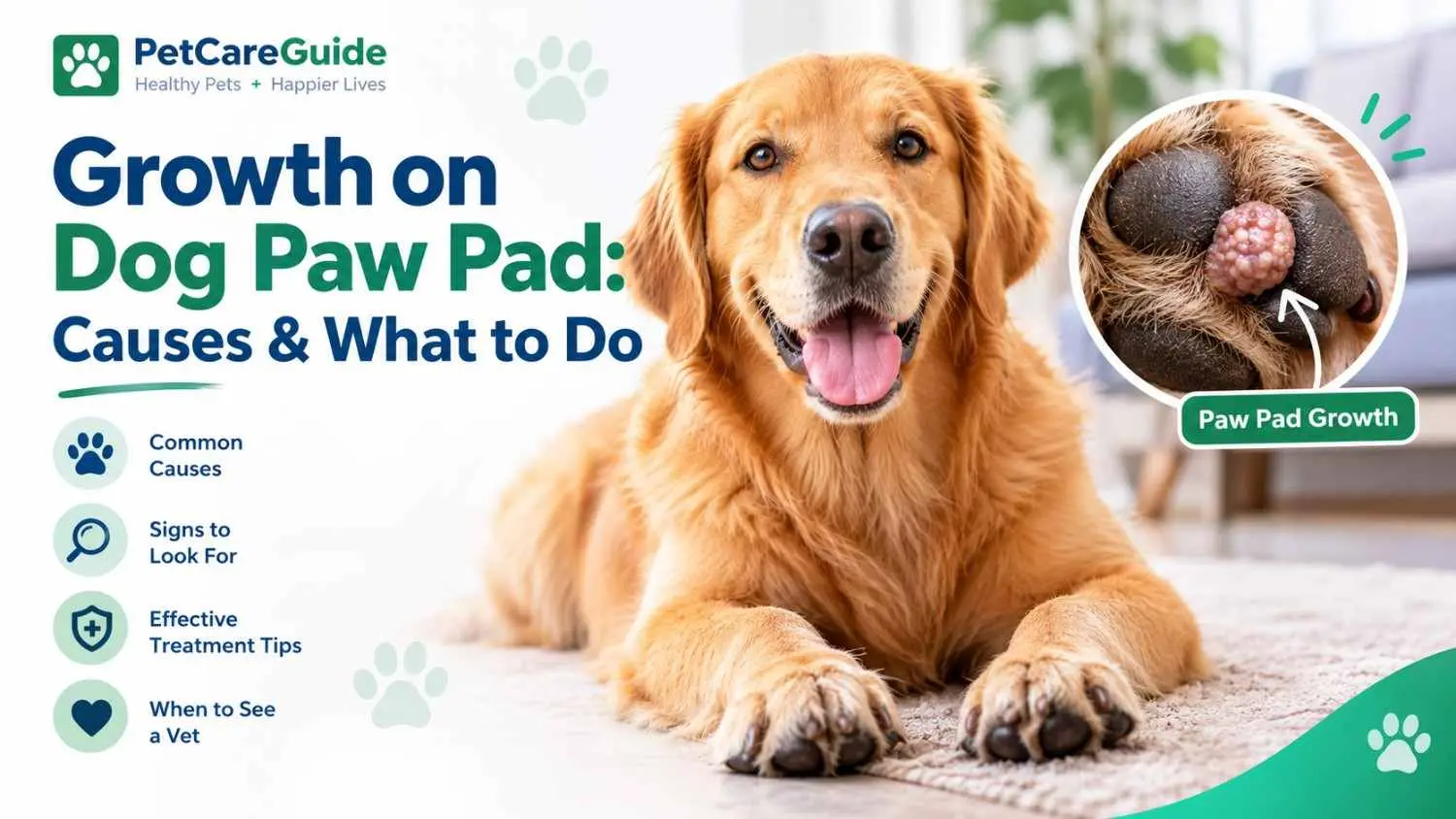
A growth on a dog paw pad can look like a small lump, hard bump, wart, thickened skin, or unusual mass. Some paw-pad changes are caused by irritation or excess keratin, while others may be cysts, corns, foreign bodies, or other growths that need veterinary examination.
Because dogs put pressure on their paws every day, even a small growth can become irritated or painful. A growth may also change the way your dog walks, causing licking, chewing, limping, or reluctance to put weight on the affected paw.
This guide explains the common causes of dog paw pad growth, what different types can look like, when a paw-pad lump may need veterinary attention, and what you should avoid doing at home.
What Is a Growth on a Dog Paw Pad?
A growth on a dog paw pad is an unusual raised, thickened, hard, soft, or lump-like area on the pad of the foot.
You may notice a:
- Small bump
- Hard lump
- Round growth
- Rough patch
- Thickened area
- Wart-like growth
- Corn-like lesion
- Cyst
- Swollen area
- Mass between the paw pads
The term “growth” does not identify a specific condition. Several different problems can produce a similar-looking change on a dog’s paw.
Common Causes of Dog Paw Pad Growth
There are several possible causes of a growth or lump on a dog’s paw pad.
Hyperkeratosis
Hyperkeratosis occurs when the body produces excessive keratin, causing the skin to become thick, hard, dry, or rough.
On the paws, excess keratin can make the pad look enlarged or unusually thick.
A thickened paw pad is not necessarily a tumor or other mass. However, persistent or unusual changes should be evaluated if you are unsure of the cause.
Corns and Keratomas
A corn on a dog’s paw pad, sometimes called a paw-pad keratoma, is a localized hard area that can cause discomfort when the dog walks.
Dogs with a corn may:
- Limp
- Avoid putting weight on the paw
- Lick the affected foot
- Walk differently
- Show discomfort on hard surfaces
A veterinarian can determine whether a hard paw-pad lesion is a corn or another condition.
Cysts
A cyst can appear as a lump or raised area on or around the paw.
Some cyst-like lesions may become inflamed, irritated, or infected, particularly when the dog repeatedly licks or chews the area.
Warts and Papillomas
A wart-like growth can sometimes develop on a dog’s paw.
These growths may have a rough or irregular surface and can be confused with other types of lesions.
A veterinarian can help determine whether a paw growth is actually a wart or something else.
Foreign Bodies
Grass awns, splinters, small pieces of plant material, or other foreign objects can become lodged in a dog’s paw.
The resulting irritation can cause:
- Swelling
- Redness
- A lump
- Persistent licking
- Pain
- Discharge
If you suspect something is embedded deeply in the paw, do not dig into the pad yourself.
Inflammation or Infection
An irritated or infected paw can become swollen and may develop a bump or mass-like appearance.
Dogs may repeatedly lick or chew an inflamed paw, which can make the problem worse.
Other Masses and Tumors
Dogs can develop different types of masses on their paws.
Some are benign, while others require further investigation. A paw growth that is rapidly changing, bleeding, ulcerated, or persistent should be examined by a veterinarian.
Dog Paw Pad Growth: What Can It Look Like?
A dog paw pad growth can have many appearances.
It may be:
- Hard or soft
- Smooth or rough
- Round or irregular
- Small or large
- Pink, red, black, brown, or skin-colored
- On top of the pad
- Between the pads
- Along the edge of the pad
- Attached to surrounding tissue
Appearance alone cannot reliably determine the cause.
Growth on the Bottom of a Dog Paw
A growth on the bottom of a dog paw can be especially noticeable because the pads make direct contact with the ground.
Constant pressure and friction can irritate an existing lesion.
Watch for signs that your dog is uncomfortable, including:
- Limping
- Refusing to walk
- Licking the paw
- Chewing the pad
- Favoring one leg
- Walking differently
- Reluctance to use stairs or jump
A painful paw-pad growth should be evaluated by a veterinarian.
Growth Between a Dog’s Paw Pads
Not every paw growth develops directly on the central pad.
A lump can also appear between a dog’s paw pads or in the webbing between the toes.
You may notice:
- Redness
- Swelling
- A small lump
- A draining area
- Persistent licking
- Pain when walking
Interdigital problems can have different causes, so persistent lumps between the toes should be examined.
Hard Growth on a Dog Paw Pad
A hard growth on a dog paw pad may be caused by thickened keratin, a corn, a keratoma, a foreign body, or another type of lesion.
Do not automatically assume that every hard lump is a tumor.
The location, duration, surface, pain level, and changes over time can help a veterinarian determine what needs to be investigated.
Thick or Crusty Growth on a Dog Paw
A thick or crusty area may be related to excess keratin, irritation, inflammation, or another skin condition.
If the thickened area continues to worsen, cracks, bleeds, becomes painful, or affects walking, veterinary examination is appropriate.
Black Growth on a Dog Paw Pad
A black spot or growth on a paw pad can have different causes.
It may represent pigmentation, a scab, dried blood, a foreign material, or another type of lesion.
Do not attempt to scrape or cut away a black growth yourself.
If it is new, changing, raised, painful, or bleeding, ask your veterinarian to examine it.
Red Growth on a Dog Paw
A red bump or swelling may indicate irritation or inflammation.
Dogs often lick red areas, which can cause additional trauma and make the paw more inflamed.
If redness is accompanied by swelling, discharge, pain, or limping, veterinary attention is recommended.
Growth on Dog Paw vs Normal Paw Pad
Normal paw pads are naturally thick and can vary in texture and color.
A potentially abnormal growth may be more noticeable because it is:
- Newly developed
- Raised above the normal pad surface
- Uneven
- Firm or unusually soft
- Increasing in size
- Painful
- Bleeding
- Associated with persistent licking
If you are unsure whether a change is normal for your dog’s paw, have it checked rather than trying to diagnose it yourself.
Signs a Paw Growth May Be Causing Pain
Dogs do not always show obvious pain.
Possible signs include:
- Limping
- Holding the paw up
- Licking the paw repeatedly
- Chewing the toes
- Avoiding walks
- Walking more slowly
- Favoring another leg
- Reluctance to run
- Difficulty walking on hard surfaces
A dog that suddenly develops difficulty walking should be assessed promptly.
When Should You See a Vet for a Dog Paw Growth?
Contact your veterinarian if the growth:
- Gets larger
- Changes shape or color
- Bleeds
- Develops an open wound
- Produces discharge
- Becomes painful
- Causes limping
- Causes persistent licking or chewing
- Does not improve
- Appears suddenly and continues to grow
- Interferes with normal walking
A veterinarian can determine whether the lesion should be monitored, treated, sampled, or removed.
How Is a Paw Pad Growth Diagnosed?
A veterinarian will examine the paw and consider the location, size, appearance, texture, and symptoms.
Depending on the suspected cause, further testing may be recommended.
Possible diagnostic approaches can include:
- Physical examination
- Examination of cells from a lesion
- Fine-needle sampling
- Biopsy
- Testing for infection
- Imaging when appropriate
The appropriate test depends on the individual dog and the characteristics of the paw growth.
Should You Remove a Growth From a Dog’s Paw at Home?
No.
Do not cut, squeeze, burn, scrape, puncture, or surgically remove a paw-pad growth yourself.
Paw pads contain sensitive tissue and are constantly exposed to pressure and environmental surfaces. An injury to the pad can be painful and may become infected.
If the growth needs treatment or removal, a veterinarian can recommend an appropriate approach.
How to Monitor a Dog Paw Pad Growth
If your veterinarian recommends monitoring the growth, keep track of changes.
Record:
- When you first noticed it
- Which paw is affected
- Its approximate size
- Color
- Texture
- Whether it is growing
- Whether your dog is licking it
- Whether your dog is limping
- Whether there is bleeding or discharge
Taking photographs can also help you compare its appearance over time.
Frequently Asked Questions
What causes a growth on a dog’s paw pad?
Possible causes include hyperkeratosis, corns or keratomas, cysts, warts, foreign bodies, inflammation, infection, and other types of masses.
Is a growth on a dog paw pad always a tumor?
No. A paw-pad growth can have many causes, including thickened keratin, corns, cysts, irritation, and foreign bodies. A veterinarian can determine whether further testing is needed.
What is the hard growth on my dog’s paw pad?
A hard paw-pad growth may be caused by a corn, keratoma, excess keratin, a foreign body, or another lesion. It is not possible to identify the cause reliably from hardness alone.
Why does my dog keep licking a growth on its paw?
Repeated licking can be a sign of irritation, discomfort, inflammation, or pain. Excessive licking can also damage the skin and make an existing problem worse.
Can hyperkeratosis look like a growth on a dog’s paw?
Yes. Excess keratin can make paw pads appear thick, rough, or enlarged. A veterinarian can help determine whether the change is hyperkeratosis or another type of lesion.
What should I do if my dog’s paw growth is bleeding?
Prevent your dog from repeatedly licking or chewing the area and contact a veterinarian. Repeated or significant bleeding should not be ignored.
Should I squeeze a growth on my dog’s paw?
No. Squeezing or puncturing a paw growth can cause pain, bleeding, tissue damage, or infection.
When is a paw-pad growth an emergency?
Seek prompt veterinary care if your dog has significant bleeding, severe pain, sudden swelling, inability to walk normally, or other serious symptoms associated with the paw.
Key Takeaway
A growth on a dog paw pad can have many possible causes, including hyperkeratosis, corns, keratomas, cysts, warts, foreign bodies, inflammation, and other masses.
Because paw-pad growths can look similar, avoid trying to diagnose or remove one at home. Monitor its size and appearance and watch for pain, licking, limping, bleeding, discharge, or rapid changes.
When a paw-pad growth is persistent, changing, painful, or affecting your dog’s ability to walk, veterinary examination can help determine the appropriate treatment.